
BaseKit Store vs Shopify
Which e-commerce platform suits small business resellers best?
For enterprise businesses who want to empower their small business customers to start selling online with their own e-commerce solution, the choice of platform matters. Two names frequently appear in this space: BaseKit Store and Shopify.
Both enable merchants to launch professional online stores, but they were built for different audiences and business models. BaseKit Store is an exclusive white-label product, designed for enterprise businesses that need a simple, resellable, e-commerce solution for small businesses, while Shopify is a direct-to-merchant platform aimed at individual businesses of many different sizes. Here’s how they compare across Simplicity, Scalability and Support.
Simplicity
BaseKit Store: Five steps to selling online
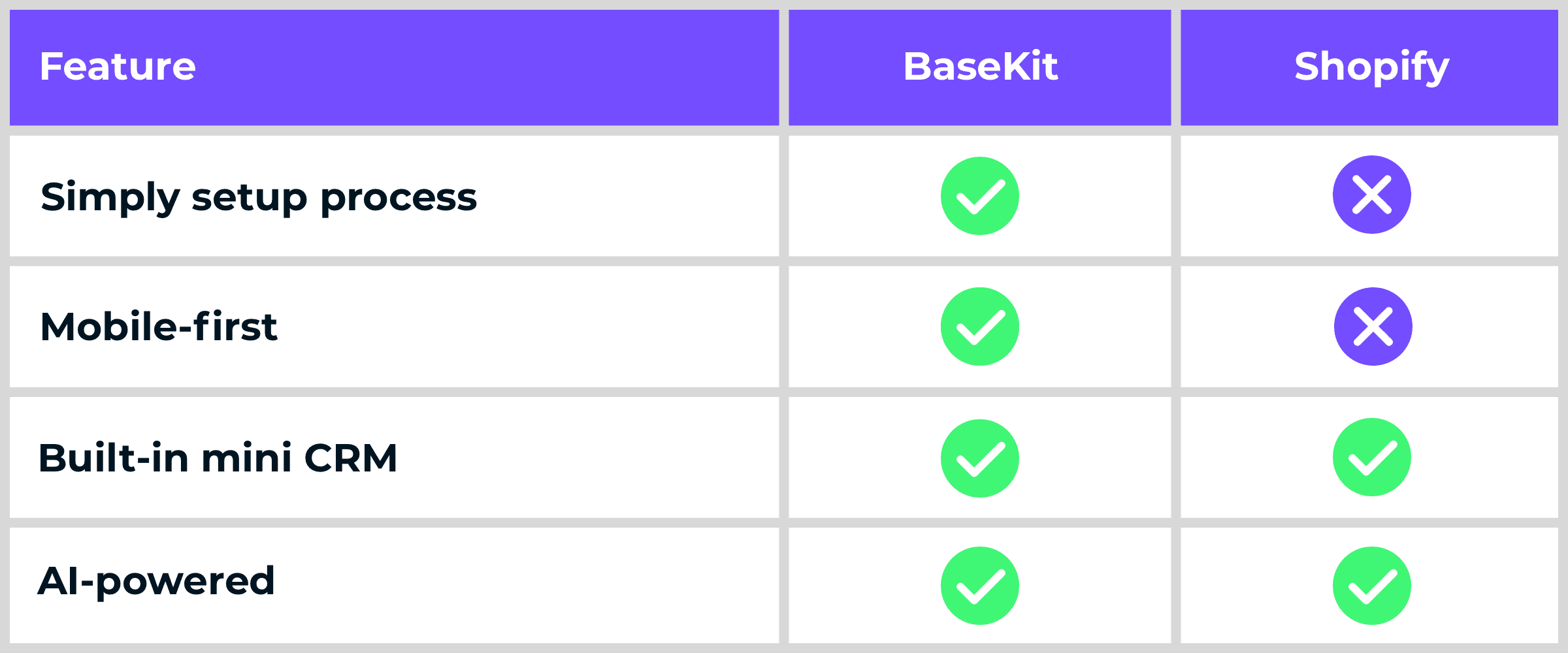
BaseKit Store was built to help small business owners, with no technical expertise, get online and start selling fast. Its hallmark is a five-step setup process that guides users from account creation to their first sale in minutes.
Merchants have access to AI assisted product management and simple inventory, shipping, analytics and promotional options to run their store with no fuss on a mobile or desktop. The UI is intuitive and the journey easy to follow, with small business owners and entrepreneurs able to launch a business quickly – all without any technical skills or coding experience.
Everything is integrated within the BaseKit ecosystem, from the website builder and e-commerce tools to bookings and a mini-CRM. This cohesive approach keeps things simple for SMBs and eliminates the need for multiple systems or plugins. Feedback from BaseKit’s reselling partners and their small business end users continues to shape development, ensuring the product remains easy to use and aligned with real customer needs.
Shopify: Feature-rich but configuration-heavy
Shopify is one of the most recognised e-commerce platforms globally, known for its broad feature set and app marketplace. It offers impressive flexibility for merchants wanting advanced marketing, inventory or sales tools. It’s continued to innovate and in recent years has introduced physical point of sale terminals and marketplace/social integrations.
However, this flexibility and breadth of e-commerce products comes with a more involved setup process. New merchants need to select plans, connect domains, choose themes and configure online and offline shopping options. For experienced users this is straightforward, but for first-time small business owners with no technical expertise it can feel complex and time-consuming.
Verdict on Simplicity
For merchants who want to start selling quickly without navigating multiple setup screens or app dependencies, BaseKit Store’s five-step setup provides a smoother, easier experience. Shopify is more comprehensive for larger, growing retailers, but it demands more configuration and ongoing management.
Scalability
Technical robustness and security
BaseKit Store: a self-contained and managed platform
BaseKit Store is part of the BaseKit platform, which powers millions of websites worldwide. The platform is fully managed by BaseKit’s operations team, who oversee hosting, uptime, security and bi-weekly product updates across all partner deployments. Because the platform is self-contained, BaseKit Store avoids compatibility issues and ensures every merchant site runs on a secure, stable foundation with the very latest product releases.
Learn more about the BaseKit approach to platform security and operations from our Technical Director, Mark Jeffries.
Shopify: global infrastructure, independent merchant focus
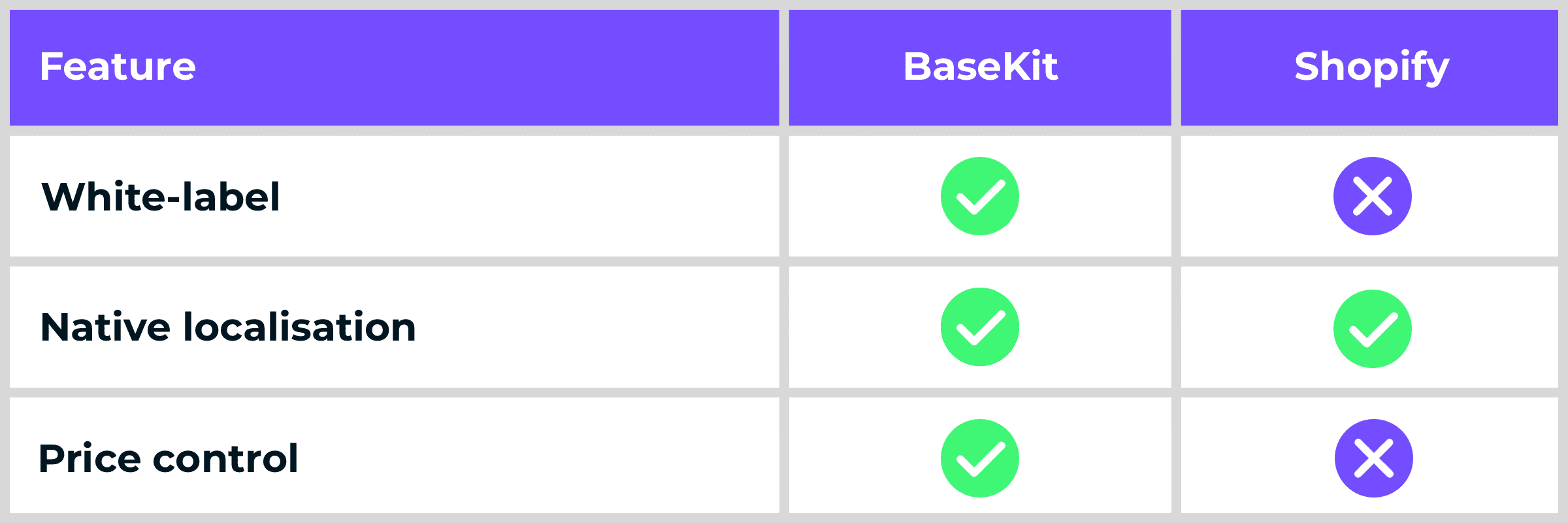
Shopify operates a powerful, cloud-based infrastructure trusted by millions of stores globally. Its reliability and uptime record are excellent, supported by a large engineering organisation. However, Shopify’s model is built around direct relationships with individual merchants, not partner-led white-labelling. This means each merchant operates within Shopify’s environment, with limited opportunities for partners to customise, brand or integrate the platform deeply into their own ecosystem.
Growth scalability and partner enablement
BaseKit Store: built to scale through partnerships
BaseKit’s go-to-market approach is designed for reseller scalability. Every partner receives far greater pricing control, onboarding support, account management and go-to-market materials to help launch and grow their e-commerce offering. BaseKit provides training and enablement resources for partner sales and support teams, helping them deliver consistent small business experiences across markets natively in 25 languages.
Shopify: scales for merchants, not resellers
Shopify scales extremely well for individual merchants, from small boutiques to large enterprises using Shopify Plus. However, it does not operate a true white-label or partner-reseller model. While affiliates and agencies can recommend or build on Shopify, they do not control pricing, branding or customer relationships. For partners looking to own the merchant experience end-to-end, this can be a significant limitation.
Verdict on Scalability
Both platforms scale technically, but in different directions. Shopify scales for individual merchants, while BaseKit Store scales for partners who want to deliver e-commerce to thousands of SMBs under their own brand with full operational control.
Support
BaseKit Store: structured for partner success
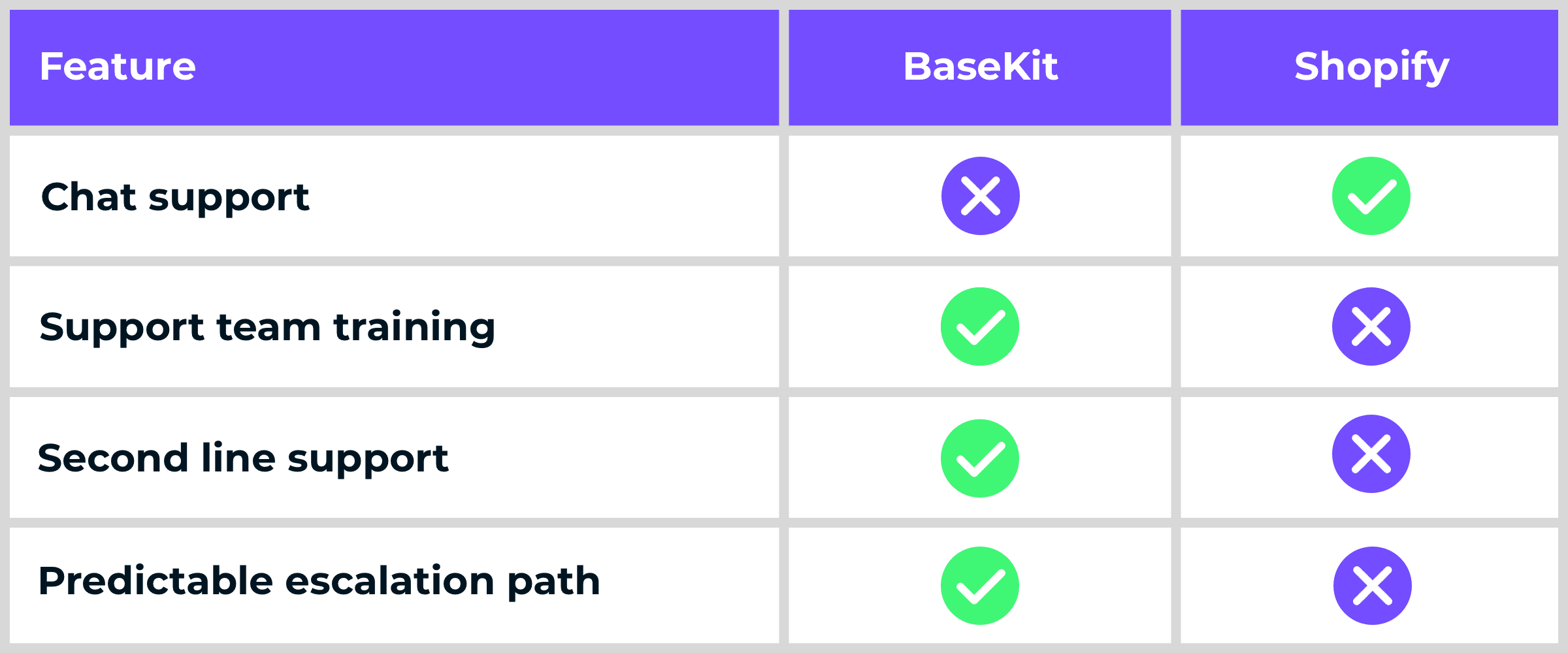
BaseKit’s support model is partner-first. Resellers receive training and access to second-line support, allowing their teams to handle small business customer queries confidently. The single-vendor setup simplifies troubleshooting, and direct collaboration with BaseKit’s support and product teams ensures quick resolution and shared learning.
This collaborative model is especially valuable for large-scale resellers who need predictable escalation paths and consistent customer service across markets.
Shopify: merchant-focused, direct support
Shopify offers 24/7 support for its merchant customers through chat, email and an extensive help centre. Its resources are strong, but they are tailored for individual store owners, not for partners managing multiple SMB clients. Agencies and affiliates can access documentation and community forums, but there is no dedicated partner escalation structure.
Verdict on Support
For resellers who need aligned partner and end-user support, BaseKit’s structured model provides clear escalation channels and training. Shopify’s support is excellent for individual merchants but not designed for partner-level operations.
Conclusion
Choosing the right e-commerce partner
- Choose BaseKit Store if you are an enterprise vendor seeking a white-label e-commerce platform designed for small businesses with no technical expertise. With its five-step setup, integrated tools and managed infrastructure, BaseKit Store lets your customers start selling quickly while your teams receive full onboarding, GTM and support enablement.
- Choose Shopify if you are an individual merchant or growing retail brand that wants advanced e-commerce capabilities and is comfortable operating directly within Shopify’s ecosystem.
Bottom line
For partner-led programs that need to deliver simple, scalable and supported e-commerce in global markets, BaseKit Store is the clear choice. For independent merchants who want complete control of their own store environment, Shopify remains a market leader.
