
BaseKit Store vs WooCommerce
Which platform helps small businesses sell online faster?
For enterprise businesses looking to help their small business customers sell online, two names often come up: BaseKit Store and WooCommerce. Both enable merchants to build and manage online stores, but their design philosophy and target audiences differ.
BaseKit Store is an all-in-one, partner-ready white-label e-commerce solution purpose-built for SMBs, while WooCommerce is a powerful but more complex WordPress plugin ecosystem popular with developers and agencies. Here’s how they compare across simplicity, scalability and support.
Simplicity
BaseKit Store: built for fast, five-step setup
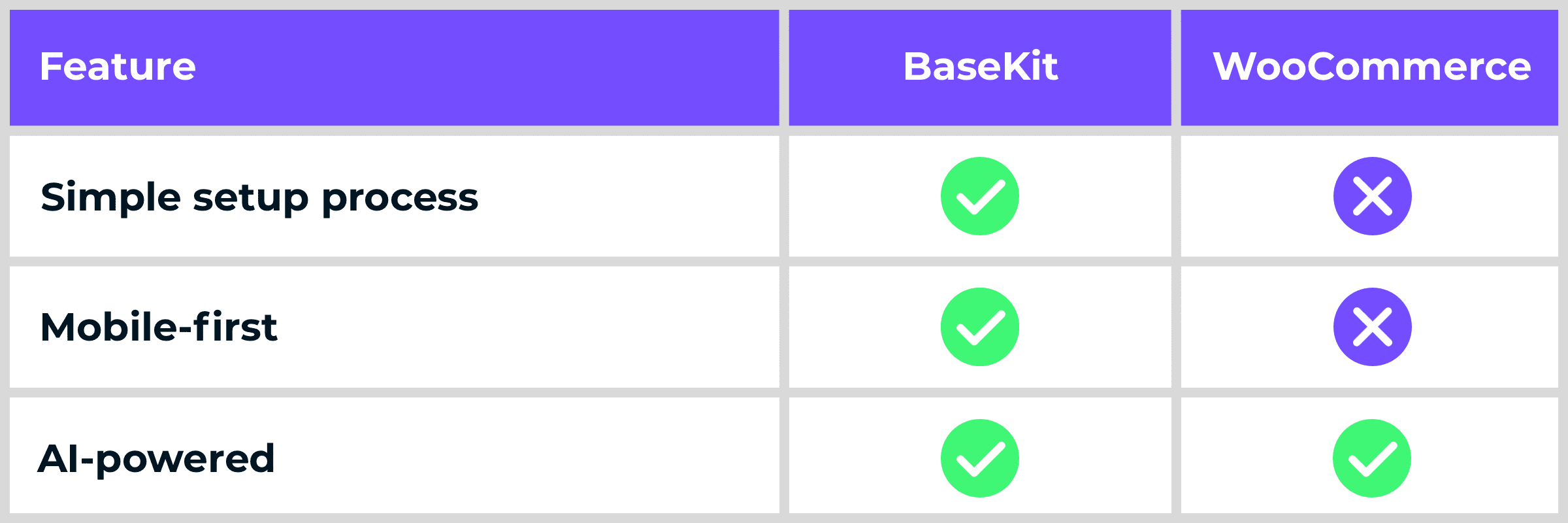
BaseKit Store is designed to get small business merchants selling online quickly. Its hallmark is a five-step setup process that guides users from sign-up to selling in minutes. Merchants can set their store name, add products, set shipping, connect a payment gateway and activate – all without needing plugins, developer input or technical knowledge. The storefront, checkout and product management tools are fully integrated within the BaseKit platform, alongside a website builder, booking software and a mini CRM.
Because everything is built by the same team, merchants and partners enjoy a consistent experience across the full suite. Feedback from BaseKit’s reselling partners and their SMB customers continues to inform each release, ensuring the platform stays intuitive and relevant for real-world users.
WooCommerce: powerful but plugin-heavy
WooCommerce is a feature-rich WordPress plugin that can transform a WordPress site into an online store. Its flexibility and developer community make it a top choice for agencies and businesses that want deep customisation. However, with that flexibility comes complexity. Setting up WooCommerce typically involves configuring hosting, installing WordPress, managing multiple plugins and themes, and maintaining updates and security patches. For non-technical SMB owners, this process can be daunting and time-consuming, often requiring ongoing developer support.
Verdict on Simplicity
For small business merchants who want to start selling quickly with minimal setup, BaseKit Store’s guided five-step process provides a much smoother entry point. WooCommerce offers unrivalled flexibility for developers, but it demands more technical effort and management overhead.
Scalability
Native languages: built-in capability vs. plugin-dependent setups
BaseKit Store: native, secure, and globally ready
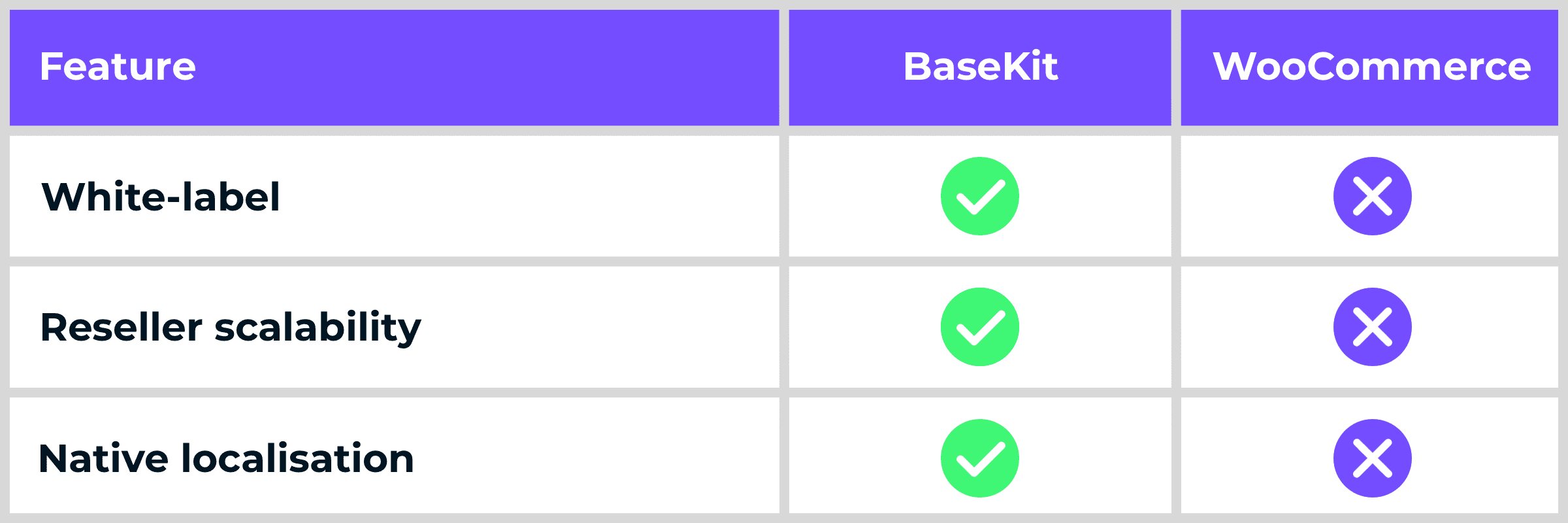
BaseKit provides 25 native languages, with multilingual publishing built directly into the platform. Because localisation is part of the core system, it benefits from BaseKit’s centralised management, security and reliability, ensuring consistent performance across all languages and templates.
WooCommerce: multilingual through plugins
WooCommerce supports up to 50 languages, but only via third-party plugins. This adds variability in performance, compatibility and security. While multilingual publishing is possible, it requires ongoing plugin management, updates and configuration to maintain stability.
Technical robustness and security
BaseKit Store: a single, managed platform
BaseKit Store is part of the broader BaseKit platform, which powers millions of websites worldwide. Managed centrally by BaseKit’s dedicated operations team, it benefits from continuous monitoring, updates and security oversight. Because the entire system – from hosting to checkout – is owned and maintained by BaseKit, partners and end users can rely on consistent performance and robust data protection.
Learn more about the BaseKit approach to platform security and operations from our Technical Director, Mark Jeffries.
BaseKit is also an agile software development house, so small incremental platform changes can be shipped often, which allows partners, and their customers, to get the very latest product features very quickly around the world, with fully automated software deployments.
WooCommerce: depends on hosting and configuration
WooCommerce’s reliability and security depend heavily on the underlying WordPress setup and the quality of third-party plugins used. Merchants must manage hosting, backups, updates and security measures, or outsource this to an agency. While WooCommerce itself is well-maintained, its open-source nature means responsibility for uptime, patches and compliance is shared between multiple vendors, increasing the operational burden for SMBs and resellers.
The platform offers extensive shipping options, including real-time carrier rates, flat rates, local pickup, and international shipping. But again, most advanced features including label printing, automated tracking and multi-carrier integration require third-party plugins or extensions.
Growth scalability and partner enablement
BaseKit Store: designed for partner-led growth
Each BaseKit partner receives dedicated onboarding and account management, ensuring a smooth rollout and integration into existing go-to-market strategies. BaseKit also provides marketing materials, training and GTM support to help partners successfully package and sell e-commerce to their SMB customers in different markets.
WooCommerce: ideal for individual merchants and agencies
WooCommerce’s open ecosystem is optimised for individual businesses and digital agencies managing client stores. It offers flexibility through plugins and extensions but doesn’t provide structured onboarding or dedicated account management for large-scale resellers. For partners wanting to deliver e-commerce at scale with consistent onboarding and user experience, these gaps can become significant.
Verdict on Scalability
For partners managing thousands of SMBs, BaseKit Store offers a stable, fully managed platform that scales predictably. WooCommerce excels in flexibility but requires more resources to maintain consistency and performance across multiple deployments.
Support
BaseKit Store: partner-first, layered support
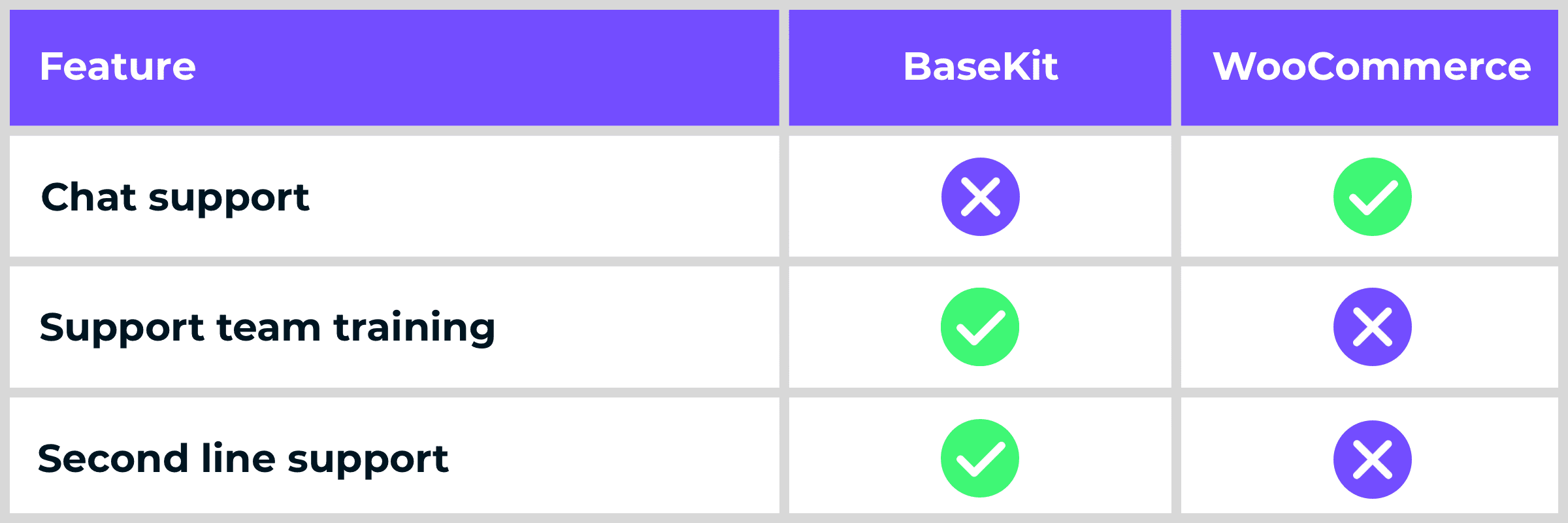
BaseKit’s support model is built for reseller collaboration. Partner support teams receive direct training from BaseKit and can access second-line support for escalations. This allows partners to handle day-to-day customer queries efficiently, knowing they have expert backup for complex issues. Because BaseKit Store runs on a single codebase, troubleshooting is faster and more predictable.
WooCommerce: community-driven and developer-focused
WooCommerce offers an extensive knowledge base, forums and community support, along with ticket-based help for paid extensions. However, it lacks dedicated partner support or escalation channels for resellers. SMB users often rely on web hosts or third-party developers for assistance, which can create inconsistency in response quality and resolution time.
Verdict on Support
BaseKit Store provides structured support aligned with partner operations, while WooCommerce’s community model suits developers and agencies managing their own client relationships.
Conclusion
Choose the platform that matches your business model
- Choose BaseKit Store if you’re an enterprise business looking to offer small business customers a fast, simple online store that is scalable to your business needs. With its five-step setup, built-in analytics tools and managed infrastructure, BaseKit Store enables SMBs to start selling quickly while giving partners confidence in reliability and support.
- Choose WooCommerce if you’re an agency or developer who wants complete control over store design, hosting and functionality, and who has the technical capacity to manage updates, plugins and performance across multiple sites.
Bottom line
For large-scale partner programs focused on enabling small businesses to sell online quickly and reliably, BaseKit Store delivers simplicity, scalability and support in one platform. For bespoke, developer-led builds, WooCommerce remains a flexible but more complex choice.
